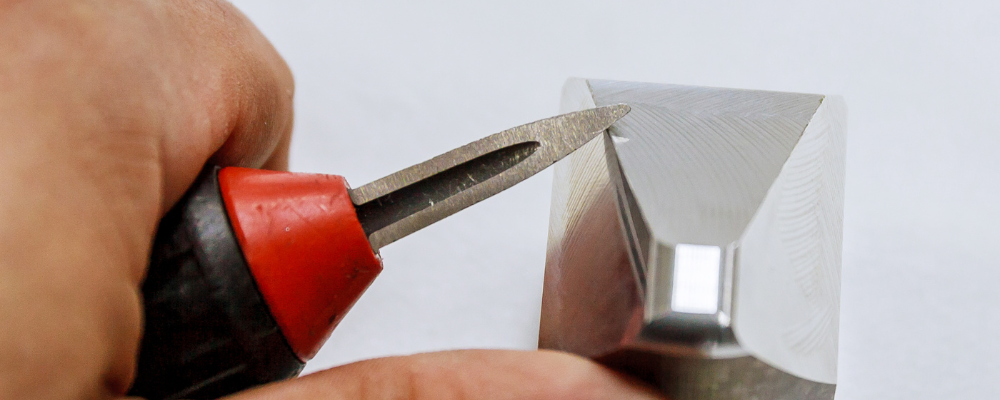
Industrial Deburring Tools: Types, Uses, and Selection Guide
What is Deburring?
Deburring is the process of removing unwanted material (typically sharp edges, burrs, or raised imperfections) from a part after machining, cutting, stamping, or grinding. These burrs form as a byproduct of metalworking processes and can impact part fit, safety, and performance if left untreated.
Why Deburring is Necessary
In industrial environments, burrs can cause real issues in production:
- Assembly problems – Parts may not fit or align correctly
- Safety risks – Sharp edges can injure operators
- Surface damage – Burrs can break off and damage adjacent components
- Reduced lifespan – Improper finishes can accelerate wear
- Stress concentration – Burrs can act as initiation points for cracks under load
- Coating problems – Burrs can prevent paint or coatings from adhering properly
In high volume operations, even small defects can scale into larger reliability issues. Selecting the right deburring tool and process helps prevent that.
Common Types of Deburring Tools
Hand Deburring Tools
Hand tools are used for low volume work, touch ups, or precision areas that require operator control. These tools typically use replaceable blades or cutting edges to remove burrs manually.
Uses:
- Cleaning up machined edges
- Removing burrs from drilled holes
- Finishing small or complex parts
Hand tools are simple and costeffective but depend heavily on operator consistency.
Types:
- Swivel blade tools that follow part contours
- Scrapers for flat surfaces or controlled edge work
Power Deburring Tools
Power tools increase speed and consistency compared to manual methods. These include electric or pneumatic tools designed to remove burrs quickly across larger surfaces or higher volumes.
Examples:
- Die grinders
- Rotary tools
- Power brushes
- Rotary burrs (carbide or HSS) used for fast material removal in metal deburring
These tools are often used in fabrication shops and maintenance environments where throughput matters.
Abrasive Deburring Tools
Abrasive tools rely on bonded or coated materials to smooth edges rather than cut them. They are used when surface finish is as important as burr removal.
Types:
- Abrasive wheels
- Flap discs
- Sanding belts
Brush Deburring Tools
Brushes use wire, nylon, or abrasive filaments to remove burrs without removing too much base material. They are useful for delicate parts or areas where maintaining geometry is important.
- Nylon abrasive filaments are used for lighter deburring and softer materials
- Wire brushes are used for heavier burrs and tougher materials
Applications:
- Cross hole deburring
- Surface finishing
- Edge blending
Hole and Internal Deburring Tools
Internal features are where deburring gets more difficult. Burrs often form on the back side of holes, intersecting passages, or inside bores where standard tools cannot reach.
These tools reach into the part to remove material from areas that are not directly accessible.
Types:
- Back chamfering tools for removing burrs on the exit side of drilled holes
- Cross hole deburring tools for intersecting features
- Internal edge deburring tools for bores and cavities
These tools are used when part geometry prevents direct access and consistent results are required.
Specialty and Application Specific Deburring Tools
Some applications require more controlled or automated processes, especially in high volume or high precision environments.
Examples:
- Mechanical deburring heads integrated into machining equipment
- Countersinks and chamfer tools used to remove burrs during machining
- High precision abrasive filament tools for tight tolerance work
- Thermal deburring systems
- Electrochemical deburring
- CNC integrated deburring tools
These methods support consistent results across large production runs.
Deburring Tools for Metal Applications
Metal parts present specific challenges depending on the material, hardness, and machining process. A metal deburring tool must be selected based on how the burr forms and how much material needs to be removed.
Considerations:
- Material type – Aluminum, steel, and stainless all respond differently
- Burr size and location – Internal edges require different tools than external edges
- Surface finish requirements – Some applications require minimal material removal
- Production volume – Manual vs. automated processes
For example, a metal deburring tool used on soft aluminum may not perform well on hardened steel. Matching the tool to the material prevents excessive wear and inconsistent results.
How to Select the Right Deburring Tool
Start with the part and process:
- What created the burr? (machining, stamping, cutting)
- Where is it located? (edge, hole, surface)
- How large is it?
Then evaluate operational needs:
- Required throughput
- Operator skill level
- Consistency requirements
- Safety considerations
A Few General Guidelines:
- Use hand tools for precision work and low volume
- Use power tools for faster removal on larger parts
- Use abrasives when finish matters as much as burr removal
- Use brushes for delicate edges or complex geometries
- Use automated systems for repeatability in high volume production
Most facilities use a combination of deburring tools to handle different part types and production demands.
Work with DXP on Deburring Solutions
Choosing the right deburring tools shouldn’t be trial and error. DXP helps match tools to your materials and machining processes. We can also support your deburring process with related products and capabilities, including abrasives, power tools, holemaking tools, turning and boring solutions, clamping systems, and metalworking fluids.
Contact a metalworking specialist today to get started.