What is a Centrifugal Pump? Parts, Types and Working Principle
Centrifugal pumps often receive little attention until performance drops or a pump fails. This article breaks down their working principle, main parts, common configurations, and industrial applications.
What are Industrial Centrifugal Pumps?
A centrifugal pump moves liquid by using a rotating impeller. Fluid enters through the suction inlet, reaches the center of the impeller and moves outward through the impeller vanes. The pump casing then converts much of the fluid’s velocity into pressure before the fluid exits through the discharge connection.
How Do Centrifugal Pumps Work?
A centrifugal pump uses a rotating impeller to move liquid and produce pressure. The basic centrifugal pump working principle follows these steps:
- Liquid enters the pump casing through the suction inlet and flows toward the center, or eye, of the impeller.
- The driver rotates the shaft and impeller.
- The impeller vanes accelerate the liquid outward, increasing its velocity.
- The liquid enters the volute casing or diffuser, which slows the flow and converts part of its velocity into pressure.
- The pressurized liquid exits through the discharge outlet.
- As liquid moves away from the impeller eye, lower pressure at the inlet draws more liquid into the pump.
Most centrifugal pumps must be filled with liquid before startup. This process, called priming, removes air from the pump casing and suction line so the pump can develop the pressure needed to move fluid.
Types of Centrifugal Pump Systems
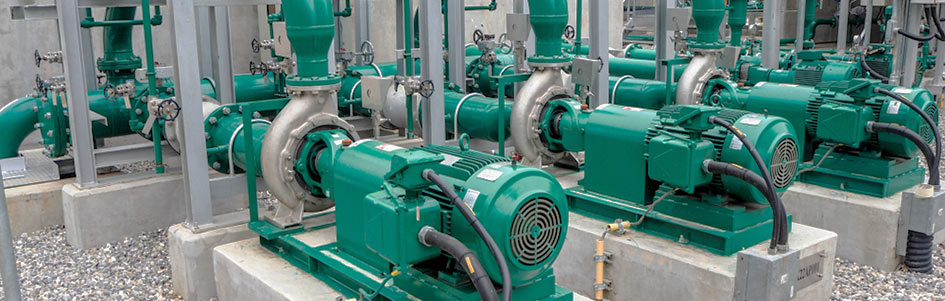
Centrifugal pumps can be classified by flow direction, shaft orientation, number of stages, and installation design. These classifications help describe how a pump moves fluid and the operating conditions it can handle.
By flow direction:
- Radial-flow pumps: Move fluid outward at a right angle to the shaft. They are commonly used for lower-flow, higher-pressure applications.
- Mixed-flow pumps: Move fluid both outward and parallel to the shaft. They provide a balance of flow and pressure.
- Axial-flow pumps: Move fluid parallel to the shaft. They are generally used for high-flow, low-pressure applications.
By shaft orientation:
- Horizontal pumps: Have a horizontally positioned shaft and allow easier access for inspection and maintenance.
- Vertical pumps: Use a vertical shaft to reduce their footprint or draw fluid from a sump, tank, or well.
By number of stages:
- Single-stage pumps: Use one impeller and are common in general fluid-transfer and circulation services.
- Multistage pumps: Use two or more impellers in series to produce higher discharge pressure.
By installation or construction:
- End-suction pumps
- Split-case pumps
- Vertical turbine pumps
- Vertical sump pumps
- Submersible pumps
ANSI vs. API Pumps
Centrifugal pumps are a staple in mechanical pumping systems across the USA, but did you know they come in different standards? The two main standards you’ll encounter are set by the American National Standards Institute (ANSI) and the American Petroleum Institute (API).
| Factor | ANSI pump | API pump |
|---|---|---|
| Common standard | ASME B73.1 | API 610 |
| Typical service | Chemical and general industrial processing | Petroleum, petrochemical and natural gas processing |
| Operating demands | Moderate industrial service | High-temperature, high-pressure or continuous-duty service |
| Design emphasis | Dimensional interchangeability and maintainability | Reliability, service life and demanding process conditions |
Common Applications of Centrifugal Pumps
Some key industrial applications that benefit from the use of centrifugal pumps are outlined below:
- Commercial food processing
- Alcoholic beverage manufacturing
- Chemical product synthesis
- Residential waterworks
- Oil and gas recovery
- Fire protection systems
- Sewage/slurry disposal systems
What Are the Main Parts of a Centrifugal Pump?
To operate properly, a standard centrifugal pump relies on several key components:
- An impeller
- Diffuser or volute casing
- Shaft and shaft sleeves
- Bearings
- Mechanical seals, Packing and Casing Cover
Impeller
The impeller is attached to the shaft and spins at the same speed as the shaft, powered by a motor, engine, or hydraulic unit. As fluid enters the impeller’s eye, it passes through the vanes, gaining velocity and kinetic energy. By the time the fluid exits the impeller and enters the casing, its velocity matches the impeller’s rotational speed.
Diffuser or Volute Casing
The diffuser or volute casing is responsible for containing the fluid and generating fluid pressure. It slows down the fluid’s velocity upon entry, converting velocity into pressure.
Shaft and Shaft Sleeves
The shaft is the central part of the pump’s rotor system. It supports the impellers, mechanical seal, and bearings. The shaft provides a rigid framework for pump operations.
Bearings
Bearings support the shaft and other rotating components within the pump’s housing. They absorb radial and axial forces during pump operation, maintaining shaft alignment for peak efficiency and reliability. Types of bearings used include anti-friction bearings, pivoted-shoe thrust bearings, and sleeve bearings.
Mechanical Seals
Mechanical seals or packings prevent the pumped fluid from leaking along the rotating shaft. They are housed within the casing cover at the back of the pump casing. The type of seal used depends on factors like the process fluid, operational temperature, and pressure.
Centrifugal Pump Diagram
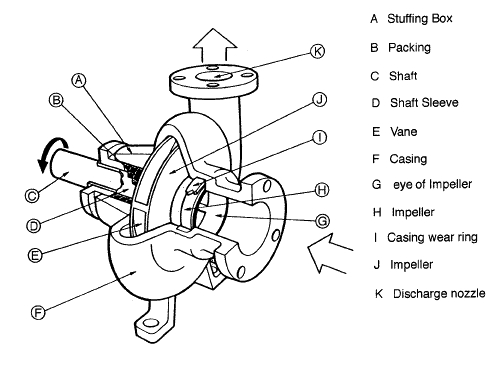
The diagram above shows the essential components of any standard centrifugal pump system.
Additional Centrifugal Pump Resources
Exploring all aspects of centrifugal pumps is a deep dive beyond one article. For those seeking more information on this essential industrial equipment, here are some additional resources:
- Different Types of Centrifugal Pumps and Their Applications
- How to Read a Pump Curve for Centrifugal Pumps
- Centrifugal Pump Maintenance Procedures for Industrial Pumps
These DXP articles offer valuable insights into operating industrial centrifugal pump systems.
Partnering with a Centrifugal Pump Supplier
Selecting the right centrifugal pump type is obviously #1, but choosing a process pump supplier who understands your specific needs is just as important. At DXP, we provide top-notch centrifugal pump solutions for various industries. Let’s optimize your pumping process together!
Contact us today to learn more about how DXP can help.