What is an Ammonia Storage System? Design, Components, and Applications
Ammonia plays a central role in many industrial processes, like fertilizer production, emissions control, or refrigeration. It is useful, but it also requires precision. Storing it the wrong way can create problems quickly, so facilities depend on systems built to handle it safely and reliably.
What is an Ammonia Storage System?
Facilities handle two forms of ammonia: anhydrous and aqueous. Anhydrous ammonia is stored under pressure or at low temperature, while aqueous ammonia (often 19% or 29%) is kept at ambient conditions and moved with pumps instead of vaporizers. The choice depends on site practices, safety policies, and downstream needs.
An ammonia storage system includes tanks, piping, pumps, controls, and safety equipment that hold and move ammonia, whether anhydrous or aqueous. The system keeps ammonia stable under the right temperature and pressure conditions while supplying downstream equipment.
You will find these systems in sectors such as:
- Petrochemical production
- Power generation (SCR units)
- Fertilizer plants
- Large refrigeration operations
Each site may use ammonia differently, but the fundamentals of safe storage remain the same.
Common Types of Ammonia Storage Tanks
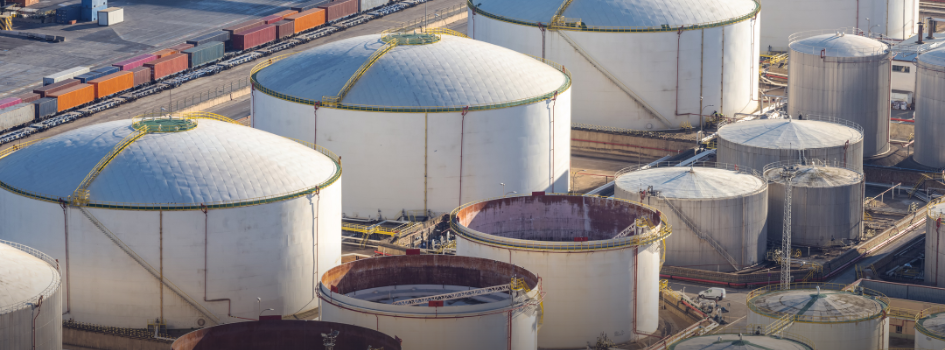
- Atmospheric Tanks – These operate at roughly -28°F (-33°C) and near atmospheric pressure. They are used for large cold‑storage volumes, often in fertilizer complexes or marine terminals.
- Pressurized Tanks – These store ammonia at ambient temperature under pressures typically between 150-250 psi. They appear in distribution terminals, SCR systems, and dosing setups. Pressurized tanks suit smaller systems because they avoid refrigeration equipment and simplify installation.
- Refrigerated Tanks – These provide low‑temperature bulk storage. Lower vapor pressure makes them suitable for large inventories in petrochemical facilities, fertilizer plants, and shipping terminals.
Aqueous Ammonia Storage Systems
Some facilities store aqueous ammonia instead of anhydrous. These solutions (19% or 29%) are easier to handle and transported at ambient conditions.
These systems use ambient‑temperature tanks and forwarding pumps rather than vaporizers. Local panels and transfer connections are selected to match site practices. Aqueous ammonia systems appear in power plants, industrial boilers, and SCR installations.
Main Components of an Ammonia Storage System
Ammonia Storage Tanks
Tanks are built from steel suited for the service conditions. Cold tanks may require insulation, and many facilities add containment measures for spill control.
Piping / Valves
Systems include transfer lines along with relief, check, isolation, and manual or automated block valves.
Instrumentation / Controls
Typical items include pressure and temperature indication, liquid‑volume measurement, leak detection equipment, and shutdown logic.
Pumps / Transfer Equipment
Facilities may use ammonia forwarding pumps, metering arrangements, loading arms, or unloading pumps depending on how the ammonia is received and used.
Safety Equipment
Common items include gas detection, alarms, shutdown valves, and vent or flare connections.
Gas detection systems often use two alarm points: a low reading for early warning and a higher point for emergency action. Many facilities install redundant sensors to improve reliability.
Pressure‑relief valves protect tanks and piping from over‑pressure. Relief headers typically discharge to a vent stack placed at a safe height. Some plants route discharge to a scrubber when required.
Design Considerations
Inspection and mechanical‑integrity planning forms part of ammonia storage design. Pressure vessels and piping are often inspected under API 510 and API 570 programs, and some sites apply API 653 for large tanks. Leak testing, visual inspection, and thickness monitoring support long‑term service.
Considerations:
- Codes: ASME VIII for vessels; ANSI B31.1 / B31.3 for piping; AWS D1.1 for structural fabrication; API guidance for tanks and instrumentation.
- Material choice: Steel suited for ammonia service and low‑temperature operation. Copper‑bearing alloys such as copper, brass, and bronze are avoided in ammonia systems. Elastomers are selected with care; PTFE, EPDM, and certain fluoropolymers perform better in ammonia service than nitrile.
- Containment: Berms or double‑wall configurations help limit the impact of a release. Secondary containment is common for both aqueous and anhydrous systems.
- Thermal needs: Refrigeration, insulation, and vapor‑control equipment are applied to atmospheric or cold tanks as needed.
- System size and layout: Industrial tanks often fall between 6,000 and 22,000 gallons. Layout planning also accounts for wind direction, ventilation, access paths, and clearances.
- Modular construction: Pre‑assembled skids help reduce field labor and streamline installation.
- Governing safety practices: Many facilities follow guidance from IIAR for ammonia systems, along with OSHA PSM and EPA RMP requirements. NFPA 30 and NFPA 55 are also referenced in some layouts.
- Environmental and emergency response: Spill containment berms are usually sized for roughly 110% of tank volume, many plants tie detection and isolation functions into their emergency‑shutdown systems.
How a Typical Ammonia Storage Setup is Arranged
A system may include the following:
- An unloading station for truck or rail delivery
- A storage tank (pressurized or refrigerated)
- A vaporizer when downstream equipment requires ammonia vapor
- Instrumentation and control panels
- Safety devices for isolation and detection
This arrangement supports steady operation and straightforward maintenance.
Truck and rail unloading points often include breakaway couplings, backflow prevention, and dedicated transfer hoses. Some facilities use vapor‑return lines during anhydrous unloading to manage tank pressure during transfer.
Modular Ammonia Storage Systems
Many facilities now prefer modular process systems built off‑site. These systems are delivered as assembled units with piping, controls, and supporting structures already in place. This approach shortens construction time and makes commissioning simpler.
Explore DXP/IFS Ammonia Storage Packages
DXP/IFS supplies packaged ammonia storage and handling systems built for demanding industrial settings. Our teams can design and assemble modular units that include ammonia storage tanks, vaporizers, controls, piping, and safety hardware. Each system is tested before shipment, arrives ready to install, and is backed by experienced engineers who support the equipment throughout its service life.
If you need an ammonia storage solution for a new project or an upgrade, our team can provide a solution.
Contact our engineering team today to discuss your requirements.