Metalworking Fluids: Types, Applications, and Selection Guide
In high precision machining, metalworking fluids are a variable that directly determines tool life, surface integrity and overall cycle time.
What are Metalworking Fluids?
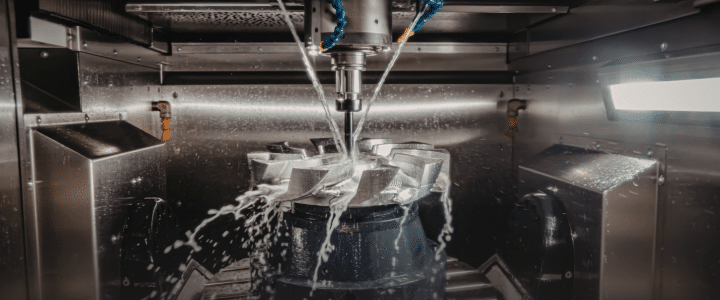
Metalworking fluids (also referred to as coolants or lubricants) are engineered liquids applied to the interface between the cutting tool and the workpiece. At the point of contact, extreme pressure and friction generate intense thermal energy that threatens tool geometry and part dimensions.
Metalworking fluids mitigate these forces by providing a protective film that reduces friction while carrying heat away from the cutting zone. Beyond thermal management, these fluids flush metal chips away from the cut to prevent the “recutting” of debris that mars surface finishes or causes catastrophic tool failure.
4 Types of Metalworking Fluids
1. Straight Oils
Straight oils are non-emulsifiable fluids composed of 100% petroleum, mineral or vegetable oil. They do not mix with water. They provide the highest level of lubrication but limited cooling.
Best for:
- Low speed operations
- Heavy duty cutting
- Threading, broaching and tapping
2. Soluble Oils
Soluble oils are emulsions that mix oil with water, typically containing 30% to 85% oil along with emulsifiers.
Best for:
- Milling and turning
- Moderate cutting speeds
- General-purpose machining
They require proper concentration control to prevent contamination and bacterial growth.
3. Semi-Synthetic Fluids
Semi-synthetics combine a lower oil content, typically 5% to 30% oil, with synthetic additives to improve performance across a range of cutting conditions.
Best for:
- High speed machining
- CNC operations
- Applications requiring cleaner systems
They offer better heat dissipation than soluble oils while maintaining lubricity and longer sump life.
4. Synthetic Fluids
Synthetic fluids contain 0% petroleum oil. They are formulated from chemical compounds designed for maximum cooling and cleanliness.
Best for:
- High-speed grinding
- Precision machining
- Operations where heat control is the priority
They provide excellent cooling but less lubrication compared to oil based fluids, which can increase tool wear in high pressure cutting applications.
Cooling vs. Lubrication in Machining
The machining process creates two types of friction: internal deformation of the material and external sliding of the chip across the tool face.
Lubrication (Low Speed, High Pressure)
Oil based fluids reduce the coefficient of friction and help prevent built up edge (BUE), where material adheres to the cutting tool and affects surface finish.
Cooling (High Speed, Low Pressure)
Water based fluids remove heat from the cutting zone, helping control thermal expansion and maintain dimensional accuracy.
Applications of Metalworking Fluids
Turning and Milling (Balanced Demands)
These operations generate moderate heat and require a versatile fluid. Because the tool is often in constant contact with the workpiece, fluid performance must support dimensional stability under continuous cutting conditions. Soluble or semi-synthetic fluids are the standard choice here.
Grinding (High Thermal Load)
Grinding involves thousands of tiny cutting edges (abrasive grains) moving at high speeds, which produces intense heat at the contact point. Synthetic fluids are preferred because their superior heat dissipation properties prevent “burning” or heat-checking of the part surface.
Drilling and Tapping (High Pressure & Friction)
In these “closed” operations, the tool is buried deep within the material, making it difficult for fluid to reach the cutting edge. Because the primary risks are high friction and chip clogging, straight oils or fluids with high lubricity additives are required to prevent the tool from seizing/snapping.
Forming and Stamping (Surface Protection)
Unlike cutting, forming involves metal deformation. The fluid’s primary job is to provide a high strength film that prevents the metal from tearing/galling the die. Straight oils or specialized extreme pressure fluids are used to handle these massive mechanical loads.
Selection Factors for Metalworking Fluids
Material Type
- Ferrous metals often require corrosion protection
- Aluminum requires fluids that prevent staining
- Exotic alloys may require higher lubricity
Cutting Speed and Heat
Higher speeds generate more heat, increasing the need for cooling focused fluids like synthetics or semi-synthetics.
Tooling and Operation
Complex tooling or tight tolerances often require better lubrication to maintain accuracy and reduce wear.
Fluid Maintenance
Fluid performance depends on proper concentration, filtration and contamination control. Poor maintenance can lead to tool failure and inconsistent part quality.
Operational Considerations
Metalworking fluids are part of the broader machining process, not a standalone input. Fluid selection should align with tooling, machine capabilities and production requirements.
Improper fluid selection can lead to:
- Premature tool wear
- Poor surface finish
- Increased scrap rates
- Machine downtime
Standardizing fluid selection and maintenance across operations helps reduce variability and improve consistency.
Select the Right Metalworking Fluid with DXP
DXP is an MRO distributor that supports industrial teams with application specific solutions for machining and metalworking processes. Our metalworking products include lubricants, coolants and metal working fluids designed for machining across different materials and cutting conditions.