How Does A Torque Wrench Work?
Every bolted joint depends on one thing: controlled torque. Torque wrenches turn that simple requirement into a repeatable process using springs, beams, sensors, and geometry. Understanding how they achieve it helps explain why calibration, technique, and maintenance matter just as much as the tool itself!
What is a Torque Wrench?
A torque wrench applies a preset twisting force to a fastener. That setting prevents over-tightening and under-tightening. In most shops, these precise measurement tools protect threads, gaskets, studs, and all sorts of parts that do not tolerate extra stress.
Torque in simple terms comes down to force multiplied by distance, which is why hand placement changes the output so much. If you think a standard ratchet can “get close,” you’ll eventually pull a stud or warp a flange.
Internal Mechanics
Torque wrenches use mechanical resistance, reference springs, and precise geometry to stop you when you hit the preset torque. Here’s how each style behaves.
1. Click-Type Torque Wrenches
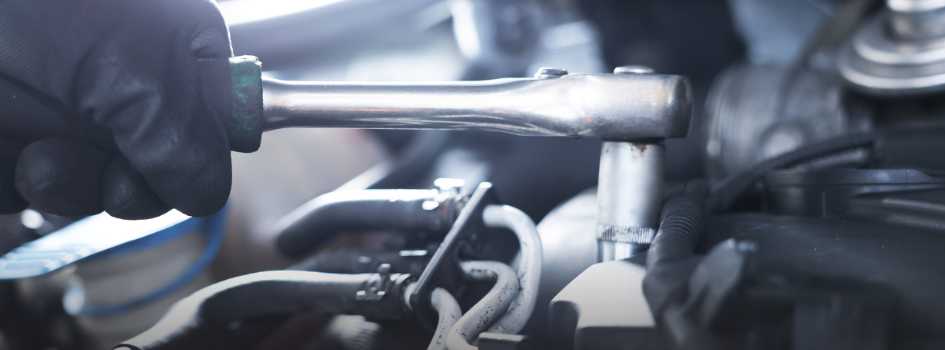
This is the one you see in most kits. Inside the handle sits a coil spring pushing on a detent or pawl assembly. You twist the handle to change the spring load, which sets your torque value.
During a pull, the internal mechanism resists movement until the preset force on the spring is reached. Once the force reaches that point, the detent snaps out of engagement. That’s the “click.” It tells you to stop pulling.
Side note from experience: Keep your hand at the grip, not halfway up the shaft. Changing hand placement changes the moment arm, and the torque output shifts.
2. Beam-Type Torque Wrenches
This design uses a long, flat beam that bends in a predictable arc as you apply force. A pointer attached to a second beam stays straight and follows a scale. You read the torque visually.
It’s the simplest style. No clicking, no springs, almost nothing to go wrong. The downside is the operator has to watch the scale while pulling, which isn’t always ideal in cramped or awkward positions.
3. Split-Beam Torque Wrenches
These resemble click wrenches but use two beams and a trigger mechanism instead of a coil spring. The preset force is controlled by the distance between those beams. Once the torque reaches the set value, the beams separate slightly and release the trigger.
They hold calibration for longer stretches because the internal spring tension doesn’t sit under load when the tool is stored.
4. Electronic Torque Wrenches
Sensors inside the head convert strain into an electrical signal. A microprocessor reads that signal and alerts you (often with a beep/vibration) once torque hits the programmed setting.
These shine in inspection work, production assembly, or places where traceability is a requirement. They also help reduce operator fatigue since you don’t rely on a click or a scale.
How Calibration Fits into All This
Torque wrenches drift with time, heat, dirt, and plain old use. Good shops test tools at set intervals. Calibration labs usually verify tools at multiple points in their range (often 20%, 60%, and 100%) following ISO 6789 procedures.
Side note from experience: Don’t wind your click wrench all the way up and toss it in a drawer. Back the spring down to its lowest setting before storage. It helps the spring hold its properties longer.
Common Missteps
Here are some industrial torque wrench related mistakes we’ve seen over and over:
- Pulling from the shaft instead of the grip
- Applying torque while the tool is still clicking
- Using the wrench as a breaker bar
- Ignoring lubrication on bolt threads when a spec calls for it
- Storing the tool loaded
None of these help accuracy, and some even shorten the tool’s life.
Temperature shifts, thread condition, and lubrication all influence torque‑to‑tension, so two identical torque readings can create very different clamp loads if friction changes.
Hydraulic Torque Wrenches
Hydraulic torque wrenches come into play when the job involves large studs, heavy flanges, or joints that call for high torque output. These tools run on hydraulic pressure supplied by a pump, which lets the wrench head stay compact for tight spots around piping, vessels, and structural connections.
There are two main styles of hydraulic torque wrenches:
- Square drive heads for general bolting where standard impact sockets fit.
- Low profile cassettes for tight clearance around flanges.
Hydraulic tools operate with a self ratcheting system and give repeatable readings thanks to the pressure-to-torque relationship built into the design. They also run quieter and lighter than older pneumatic systems.
How a Hydraulic Torque Wrench Behaves in Use
The wrench advances using hydraulic pressure. As pressure rises, the piston pushes the tool’s drive arm forward. Reaction is taken through a reaction arm that braces against a solid surface. Once the stroke finishes, the mechanism resets for the next stroke.
Most hydraulic systems follow a simple pressure-to-torque relationship expressed as T = K × P, where K is tool specific and P is system pressure.
Operators see the best results when the fasteners are lubricated and when pressure is monitored carefully.
Industrial Torque Wrench Types
Beyond hydraulic options, several powered torque tools show up across plants, pipelines, and renewable sites:
- Pneumatic torque wrenches for work in areas with flammable vapors or where airflow is already available.
- Electric torque wrenches for higher accuracy and digital reporting.
- Battery torque wrenches for mobility when cords and hoses get in the way.
In day to day industrial work, these tools handle bolting on turbines, mining equipment, conveyors, pipelines, valves, exchangers, reactor covers, and general structural joints. Anywhere heavy bolting shows up, you’ll see hydraulic/pneumatic/electric torque tools doing the job.
Browse DXP’s Tools & Industrial Supplies Today
Do your crews need industrial torque wrenches, hydraulic torque systems, or powered torque tools built for heavy bolting work? DXP has all the precision instruments you need to make measuring, calibration, and quality checks in your manufacturing process simple. We’re your trusted industrial tool supplier!
Contact a DXP expert today to learn more about our industrial equipment supplies.